
Sedgwick County Directory Offices
Three county offices form the core of a Sedgwick County residents directory search. The Appraiser maintains parcel and valuation facts. The Register of Deeds preserves recorded instruments and party indexes. The Election Office administers registration data and points individuals to VoterView. The Sedgwick County street directory gives the full address-first workflow. Court records are held separately by the Kansas Judicial Branch and the 18th Judicial District, so a county KORA request does not reach state court files.
Sedgwick County Register of Deeds
100 N Broadway, Suite 105
Wichita, KS 67202
316-660-9400
Sedgwick County Appraiser
271 W Third Street North, Suite 501
Wichita, KS 67202
See official office page
Sedgwick County Election Office
County election administration
Wichita, KS
316-660-7100
Sedgwick Parcel Search Fields
The county property-tax and appraisal interface starts with a disclaimer, then asks for real or personal property. For real estate, the search can use an address, address only, an address range, PIN, AIN, or GeoCode. A parcel is a mapped tract used for tax records. The displayed owner and mailing address identify the tax record's parties, not every person living on the land.
| Search choice | Best use | Important limit |
|---|---|---|
| Address | One known site, with city after a comma | Spelling and direction must match |
| Address range | Several numbered sites on one street | Shows parcels, not a household roster |
| PIN, AIN, GeoCode | A known county parcel identifier | Identifiers can change with parcel work |
The result can include the legal description, property address, owner and mailing address, values, sale facts, building traits, tax units, and payment history. The Sedgwick property search shows the live entry choices.
The official interface is visible in the county's captured search screen.
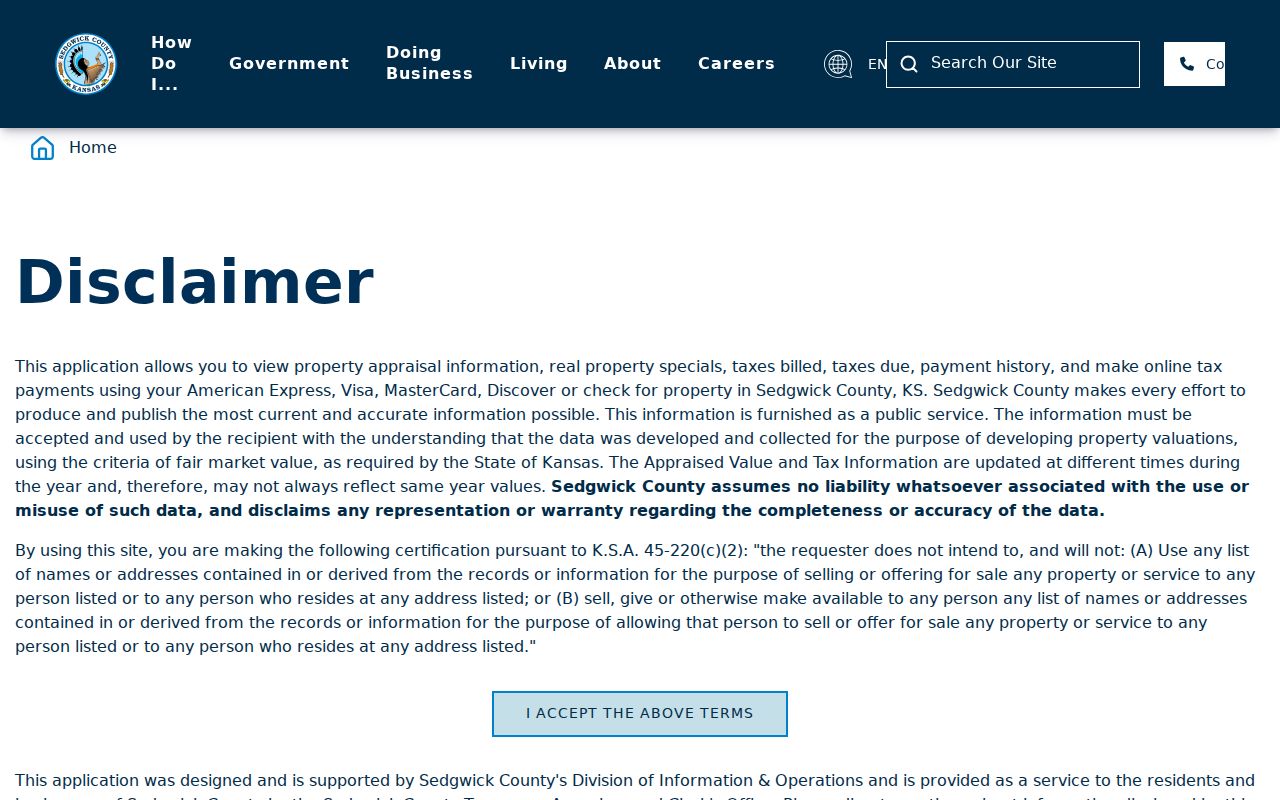
Its address and identifier routes help separate a parcel match from a loose name match.
Mapping Sedgwick County Residents
Mobile Land Records adds geography to the resident rolls. Search an address or intersection, or use a PIN, GeoCode, AIN, subdivision, block, lot, township, range, and section. The parcel popup may show the property and mailing addresses, owner, legal description, values, sale year, year built, and tax link. County parcel lines are tax-purpose mapping and are not survey-grade.
The Mobile Land Records viewer is especially useful when an address search returns several parcels.

The map places each result in a block, but the parcel owner still should not be described as the current occupant without another dated source.
Key distinction. A situs address is the property location. A mailing address is where the county sends a notice. They may differ.
Deed Names in Sedgwick Records
The Register of Deeds connects names to recorded transactions. Tapestry EON accepts party name, document number or type, date range, subdivision, lot and block, parcel, tract, and book and page. A grantor gives an interest; a grantee receives one. Neither role, by itself, proves residence. The county lists deeds from 1945 forward and other instruments from 1969 forward in the public online layer, while older work may require index books or microfilm at the office.
Remote Tapestry searches cost $8.75 and image printing costs $1 per page. Free public computers are available at the Register of Deeds. Laredo provides subscription access. These are three distinct channels, and the counter route matters when an image or older index is absent online.
The county's online land-search instructions explain the date limits and in-person fallback.
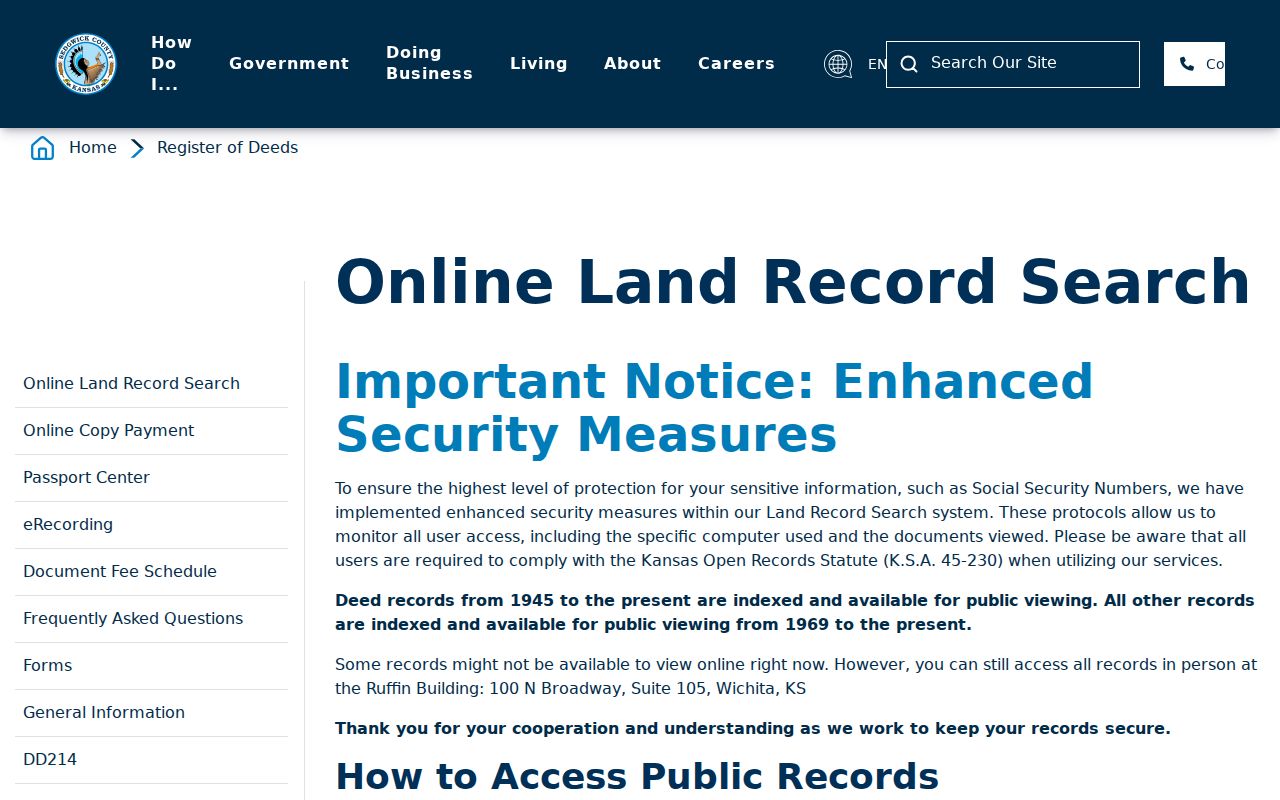
The guide is the safer starting point than treating a paid index result as a complete chain of title.
Note: For an early deed, use the Clerk's last-transfer date and party names before moving backward through Register of Deeds books.
Kansas Voter Records for Sedgwick
VoterView is an individual status tool, not a broad public resident export. It asks for first name, last name, and date of birth. A matching response can provide registration and polling information, party association, mail-ballot status, and a sample-ballot route when available. The date and self-reported nature of the record must stay attached to any conclusion.
The county also accepts voter-data orders. Its current form offers countywide or district data. Countywide data costs $50 and is delivered on a flash drive because of volume; an advance-voter package costs $120. Use is restricted by K.S.A. 25-2320 and 25-2320a, including the signed notice concerning prohibited commercial use. The Election Office remains the source for file questions and corrections.
Verify Sedgwick Residents in Court
The 18th Judicial District and Kansas court systems index cases by party and case details. A court row may supply a party name, case number, filing date, case type, location, and status or disposition. A disposition is the recorded outcome or current procedural status. It does not provide a biography or prove that an address remains current.
Search spelling variants, middle initials, and a narrow date range. Compare the case number, county, role, and filing dates before treating same-name rows as one person. Some documents are sealed, restricted, or available only through a public terminal or records request. The 18th Judicial District records office supplies local access details. Federal cases use PACER and the federal court rather than the county.
Record a failed search as “not found under these terms on this date.” A portal cutoff, spelling difference, sealed file, or older case conversion can all produce no result.
Current Sedgwick County Directory Sources
Current resident questions split across public roles. The property roll names the party tied to a parcel. VoterView checks an individual registration. Court records identify case parties. State professional records identify a credential holder, while business filings identify an agent or company office. Those roles can overlap, but they are not interchangeable.
The Kansas professional license portal provides an official name and credential route.
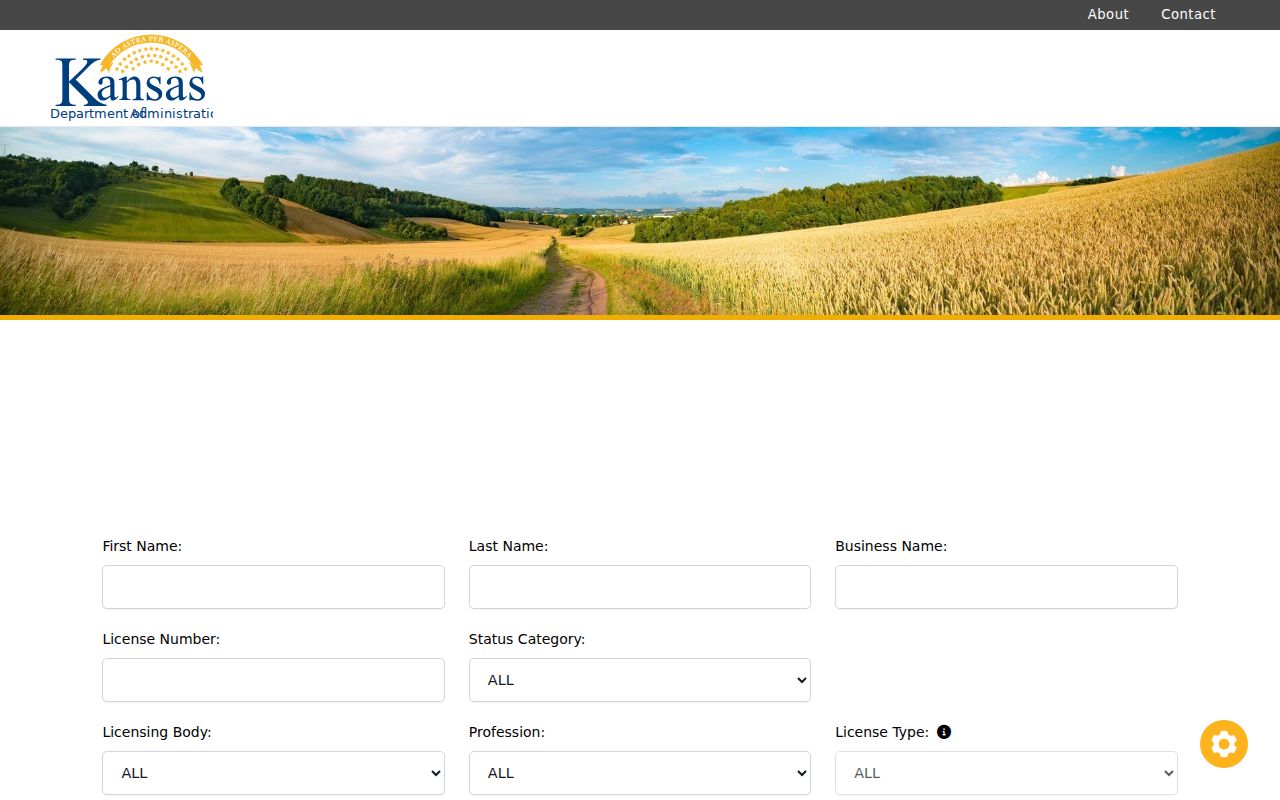
The captured portal may confirm the profession, board, license status, endorsements, discipline, and update date that a participating body makes public. It does not establish residence.
Wichita license and permit databases add applicant, permit holder, business, or project roles. Keep each exact label. A business or permit address may be a work site, office, mailing point, or project location.
Sedgwick Names in Kansas Filings
The Kansas Secretary of State search can distinguish an entity, resident agent, and principal or mailing office. Search exact and variant business names, then save entity status, filing identifier, date, and the role printed beside any person. “Resident agent” means the party designated to receive legal service for the entity. It does not mean the person lives at the listed office.
The official Kansas business entity search shows the statewide route.
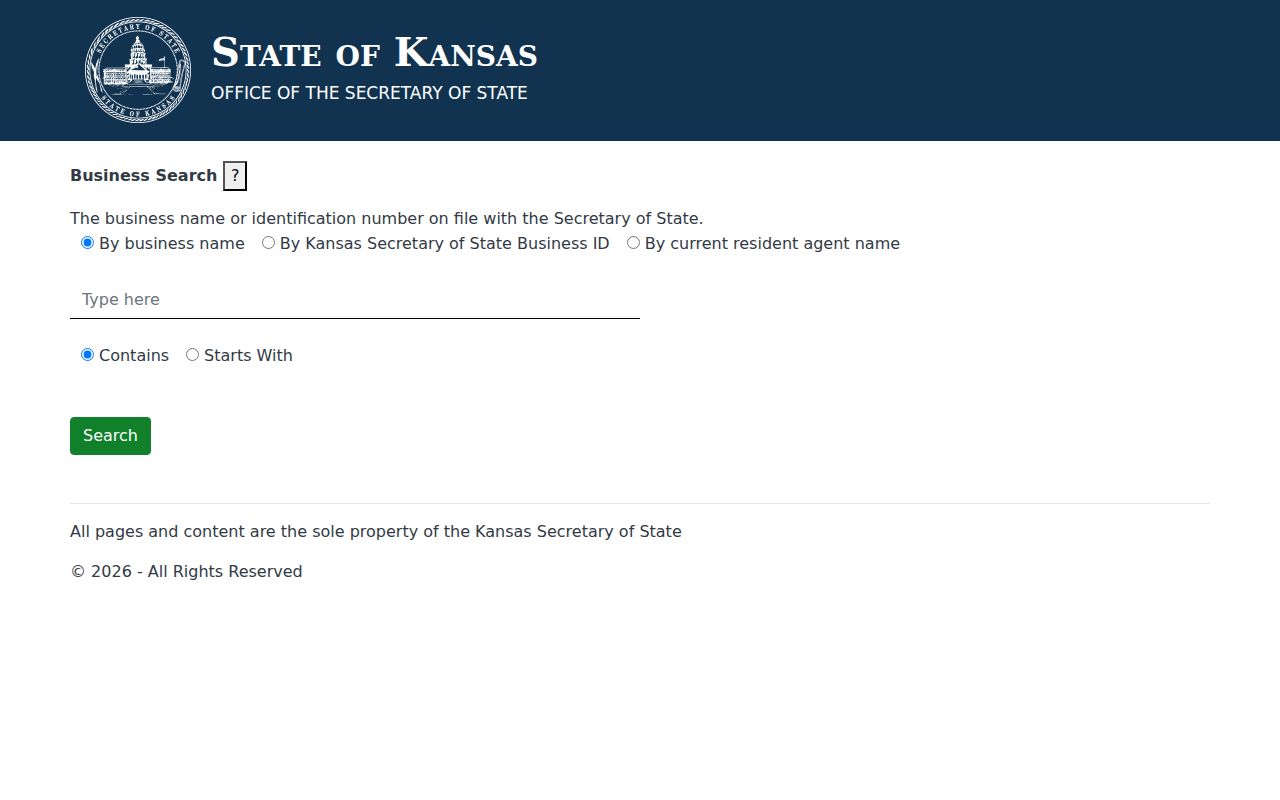
The interface is useful for a dated business relationship. Consult the original filing when the exact person, address, or effective date matters.
Historical Sedgwick Residents Directory
Wichita Public Library's Burns Historical Research Pavilion and the Midwest Historical & Genealogical Society provide the strongest directory routes. MHGS reports Wichita volumes from the nineteenth century through 2006, suburban Sedgwick directories from 1957 through 1995, and telephone or criss-cross books from the 1930s. The digitized 1892 volume includes alphabetical residents, occupations, house numbers, street listings, and a block-number key.
Use a directory as a dated publication. Abbreviations such as r, bds, and bdgh describe the printed relationship. They do not prove ownership or continuous residence. Pair the edition with a census, newspaper, deed, Sanborn map, or later directory. Public federal schedules extend through 1950. Kansas schedules for 1875, 1885, 1895, 1905, 1915, and 1925 help bridge the lost 1890 federal census.
The Sedgwick County directory book page covers the collections in depth. Library microfilm scanners can save or email JPG and PDF files at no charge; paper copies cost $0.25.
Sedgwick County Directory Geography
Sedgwick County includes 20 cities, Wichita neighborhoods, rural routes, and postal labels that do not always match political borders. The official ZIP map gives dual city associations to 67204, 67219, 67220, and 67226. Store the site city, postal city, owner mailing city, ZIP, tax unit, and political jurisdiction as separate fields.
A ZIP can narrow a large result set, but it cannot identify a block or prove residence. McConnell Air Force Base has its own postal context, and Wichita labels may sit near Park City or Bel Aire boundaries. The Sedgwick County ZIP code directory explains those county polygons and boundary traps.
Rural land may be indexed by section, township, range, subdivision, lot, or block before it has a familiar street form. Bridge the legal description through deeds, plats, and GIS rather than forcing a modern mailing label onto an older record.
Sedgwick Resident Custody Records
The Sheriff's inmate search is a current custody source. A result may show a booking or inmate identifier, name, booking date, charges, bond, and custody status. It is time-sensitive. It does not establish guilt, a permanent address, or identity without matching identifiers. Court dockets remain the source for filed events and outcomes.
The official Sedgwick inmate search displays the county route.
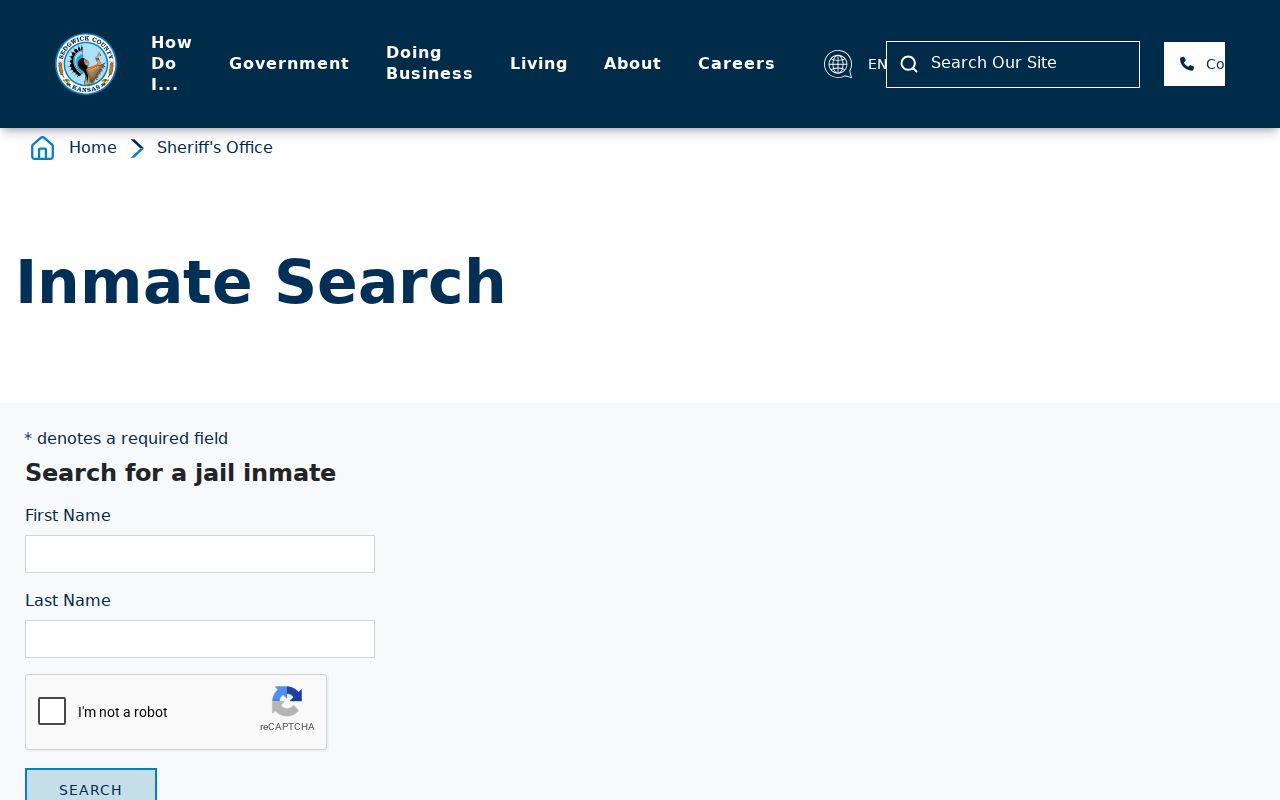
Cite the retrieval time because release, bond, and custody facts can change quickly. Never connect the row to a resident from name alone.
Request Sedgwick Resident Records
The Kansas Open Records Act, K.S.A. 45-215 through 45-223, provides the framework for identifiable county records. A useful request names the department, record type, date range, address or case identifier, and preferred format. Ask for an existing record, not an explanation or a new compilation. The custodian may assess fees, seek clarification, withhold exempt material, or refer the request elsewhere.
The county's open-records request form is the documented fallback.
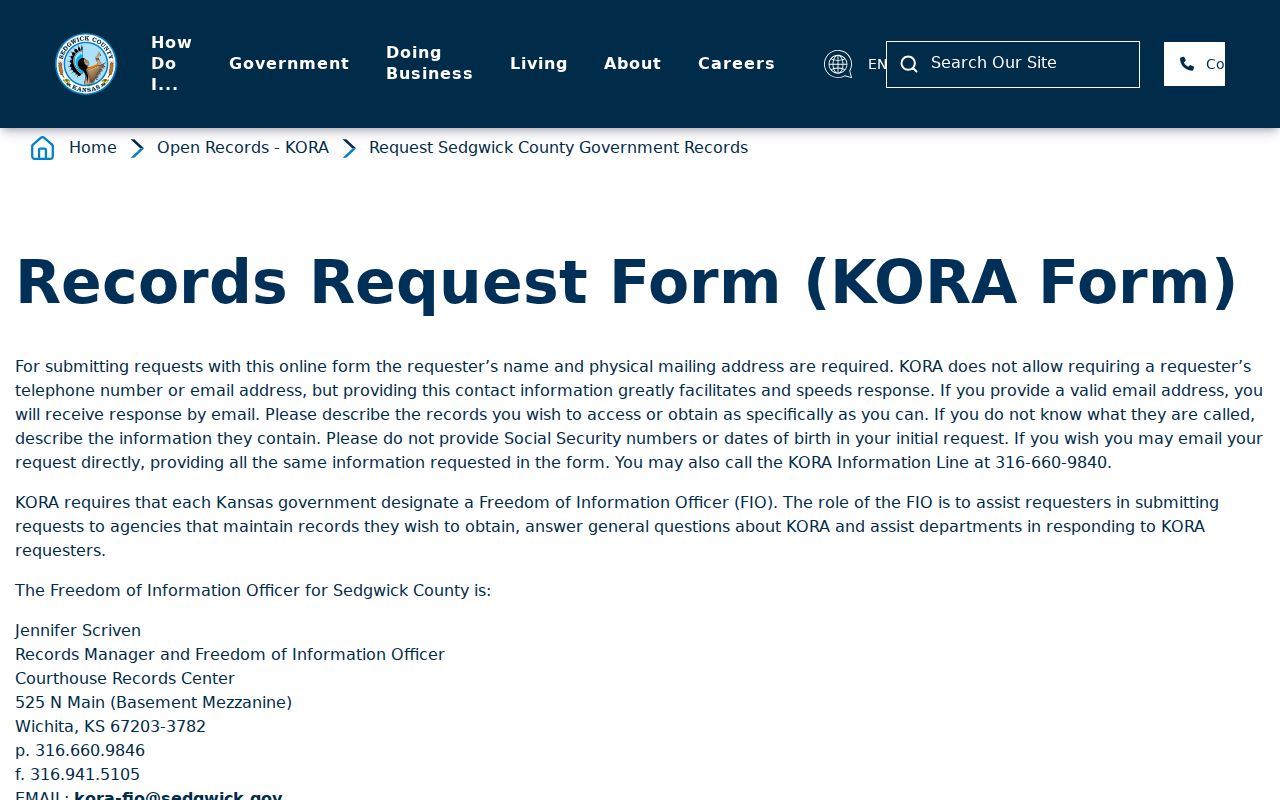
The form reaches county records. Kansas court files, Wichita municipal records, and state-agency records go to their own custodians. Keep the submitted wording, confirmation, fee quote, response date, and any cited exemption.
Sedgwick Directory Records Through Time
The Register of Deeds FAQ identifies September 20, 1870 as the county's first recorded deed. It names Amos A. Lawrence as purchaser from the United States Government and says the deed was signed for President Andrew Johnson. It does not publish the instrument number, book, page, image, parcel ID, or full legal description. Those fields remain unresolved until the original record is checked.
Wichita's 1892 directory explains its Main and Douglas center and 100-number blocks. Kansas birth and death filing began in 1911, marriage-license filing in 1913, and divorce certificates in 1951. Modern county GIS began after mapping consolidation in 1996, while Tapestry EON launched in 2025. These dates explain why one portal cannot cover every era.
A gap is usually a custody or conversion question, not evidence that no record exists. Identify the year and type, locate the office or contemporary book, test the index, then move to an image, microfilm, archive, or public terminal.
Sedgwick Residents in Local Archives
Wichita Public Library is the broadest public starting point when a modern portal stops. The Burns Historical Research Pavilion holds more than 25,000 genealogy volumes, census and newspaper microfilm, reference-only city directories, maps, telephone books, local newspapers, and FamilySearch Center access. Its digital microfilm scanners can save or email JPG and PDF files without charge. Paper copies cost $0.25. Staff also accept narrow building, person, or obituary fact checks by mail or email at $5 per half hour, for no more than one hour, plus copy charges. That service is meant for a defined question, not open-ended family or census research.
The Midwest Historical & Genealogical Society adds directory, cemetery, and local genealogy depth. Kansas Historical Society keeps Sedgwick County court, probate, marriage, tax, death, newspaper, Sanborn, and municipal holdings in volumes, boxes, and microfilm. Wichita State University Special Collections contributes yearbooks, campus publications, photographs, local manuscripts, aviation history, and early township-map projects. Its Tihen Notes summarize Wichita newspaper reading, chiefly from 1872 through 1982, but each note should be checked against the original issue.
Choose the archive by record type and year. A photograph can place a building in context, but it does not prove an occupant. A cemetery entry proves a burial record, not a former home. A yearbook establishes school publication context, not a present address. Preserve the collection title, item or roll number, page, repository, date, and access condition. If a digital image is missing, ask about a reading-room appointment, a microfilm loan or scan, a focused reference request, or the state archive finding aid rather than concluding that the record was lost.
Wichita's aviation, railroad, cattle, and neighborhood history also changes how older entries read. Early volumes may classify a person by a stockyard, hotel, livery, railroad, or real-estate role, while later archives include aircraft plants and university material. Search the abbreviation as printed before expanding it. For rural families, an early township map or the 1882 county atlas may provide section, township, range, or plat context before a street address existed.
Use Sedgwick Resident Records Carefully
Keep owners, occupants, mailing contacts, deed parties, voters, licensees, business agents, court parties, and permit holders in their printed roles. A shared surname, street, or ZIP does not prove identity. Kansas Safe at Home lets qualifying participants use a substitute address and mail forwarding in public-agency records, so protected information must never be reverse engineered.
Official records support genealogy, reconnection, estate and heir work, seller verification, civic transparency, and personal safety. They should not become an assembled current-person list. Verify changing facts with the custodian, correct false matches, and publish no more personal detail than the lawful question requires.
Commercial people-search products may merge old sources without clear dates or field labels. Treat such a result only as a lead. Return to the county, court, library, or state office that created the underlying record.